LibreInfra Newsletter
Ownable Infrastructure Dispatch: Sovereignty, Platforms and Hardware
A LibreInfra dispatch on sovereignty, agent authority, platform operating models, edge autonomy, industrial data and physical infrastructure.
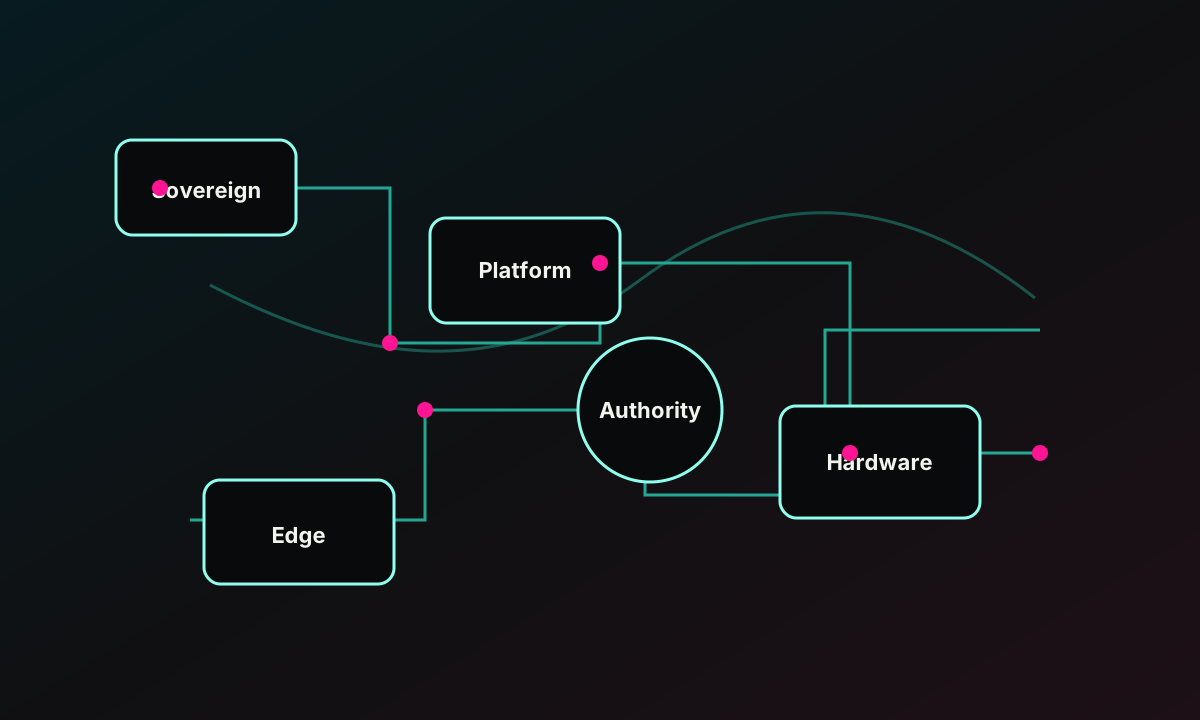
Ownable Infrastructure Dispatch: Sovereignty, Platforms and Hardware
This dispatch collects ten Field Notes on the parts of infrastructure ownership that become visible once a system has to keep operating through supplier change, site disconnection, platform failure or hardware replacement.
The issue looks at sovereignty, delegated AI authority, Kubernetes, infrastructure as code, edge autonomy, industrial data layers, server selection, legacy hardware boundaries, accelerator sizing and the physical operating system around a server fleet.
Why group them together
Sovereignty is not the nationality of a supplier. It is the ability to change course without losing authority, continuity or institutional purpose. AI agents raise the same question in a different form: once software can act with delegated authority, identity, memory, tools, budgets and evidence become infrastructure boundaries.
Kubernetes and infrastructure as code show why tools do not create operating models by themselves. A cluster can be healthy while storage, identity, controllers and recovery remain unowned. Configuration files can be complete while state, providers, credentials and execution paths remain fragile.
Edge systems and industrial data platforms add locality and time. Edge compute is not autonomous unless the site can survive loss of the centre. Brokers, historians and data lakes are not interchangeable because movement, operational history, analysis and archive all have different contracts.
Hardware makes ownership physical. A server type is a workload decision. Legacy systems such as the R730 generation can be useful only inside a deliberate boundary. GPUs run LLMs because memory movement is the real workload. A fleet remains ownable only when power, cooling, firmware, management controllers and spare parts are operated as a system.
One question for the next architecture review
Choose the platform most often described as flexible and ask:
Which decision would become difficult if the supplier, site connection, control plane, original operator or hardware platform changed at the same time?
The answer shows whether optionality is real or only assumed.
Related reading
Continue from here

Digital sovereignty is the ability to change course
A LibreInfra field note on digital sovereignty across authority, data, identity, operations, interoperability, open source and exit capacity.
Read more
Kubernetes is an orchestration engine, not an operating model
A LibreInfra field note on treating Kubernetes as one control plane inside a wider platform contract.
Read more
A server fleet is a power, cooling, firmware and spare-parts system
A LibreInfra field note on physical infrastructure control planes, BMCs, firmware baselines, spares and hardware recovery.
Read moreMake the next decision with clarity